

At 6pm on July 23rd, 1914, Baron Wladimir Giesl von Gieslingen - ambassador of the Austro-Hungarian Empire to Serbia - walks into the Serbian foreign ministry and hands over a document.
It is ten pages long. It contains ten demands. It gives Serbia 48 hours to respond.
Then he goes back to the embassy and finishes packing his bags.
He had started packing before he delivered it.
This detail - small, almost bureaucratic - tells you everything about what is actually happening in Europe on July 23rd, 1914. The ultimatum is not a negotiation. It is not a sincere list of grievances from one sovereign state to another. It is a mechanism. A legal formality dressed up as diplomacy, designed to produce a specific outcome regardless of what Serbia says or does.
The outcome: war.
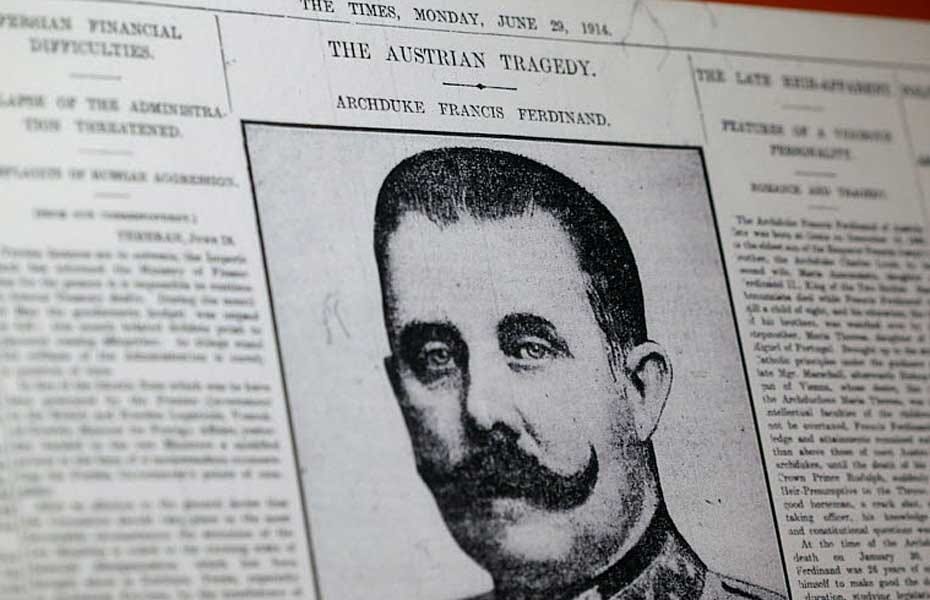
Four weeks earlier, a 19-year-old Bosnian Serb named Gavrilo Princip had stood on a Sarajevo street corner and fired two shots into the car carrying Archduke Franz Ferdinand - heir to the Austro-Hungarian throne - and his wife Sophie. Both died within the hour. The shots were heard around the world, as the saying goes. What nobody understood yet - not Princip, not the Archduke’s grieving family, not the diplomats now drafting telegrams in Vienna and Berlin - was how far those two shots would travel.
In Vienna, the hawks in the imperial government see what they have been waiting for: a legitimate reason to crush Serbia once and for all. The Balkans have been a problem for decades. Serbian nationalism is a direct threat to the empire’s territorial integrity. Now there is a dead archduke and a smoking gun and a story that can be told.
All they need is a document.
British Foreign Secretary Sir Edward Grey reads the ultimatum when it arrives on his desk. He has been in diplomacy for years. He has seen hard negotiations, aggressive posturing, the full range of great-power pressure.
He has never seen anything like this.
“The most formidable document,” he writes, “I have ever seen addressed by one state to another that was independent.”
THE DECISION:
Here is what Serbia faces:
Ten demands. Accept Austrian officials conducting their own investigation on Serbian soil - a direct violation of sovereignty. Suppress all anti-Austrian newspapers, books, and organizations. Dismiss any military officer or government official that Vienna names, without appeal or review. Answer in 48 hours.
Here is what Serbian Prime Minister Nikola Pašić knows:
The ultimatum was designed to be rejected. Vienna drafted it in coordination with Berlin specifically to produce a refusal - giving Austria-Hungary the pretext it needs to declare war without appearing to be the aggressor. Pašić is not naive. He has been in Serbian politics for decades. He can read a trap.
He also knows this: Russia - Serbia’s powerful ally - has privately signaled it will not stand aside if Austria attacks. That changes the arithmetic entirely. A war between Austria-Hungary and Serbia does not stay a war between Austria-Hungary and Serbia.
Here is what nobody in this room fully understands:
That Russia mobilizing means Germany mobilizing. That Germany mobilizing means France mobilizing. That France mobilizing means Britain - bound by treaty to defend Belgian neutrality - entering a war it has no direct stake in, against an enemy it has no particular quarrel with, to honor a guarantee made to a country most Britons couldn’t find on a map.
The alliance system is a loaded gun pointed in every direction at once. Nobody built it to fire. Nobody knows how to put it down.
Pašić has 48 hours to find a response that is neither capitulation nor provocation.
July 23rd, 1914. Belgrade. The ultimatum is on the table. Accept everything and lose your sovereignty. Reject anything and give Vienna its war.
What do you do?
WHAT HAPPENED:
Pašić works through the night.
What he produces is one of the most carefully constructed diplomatic documents of the 20th century. Serbia accepts nine of the ten demands - almost everything. The one point it cannot accept: Austrian officials conducting independent investigations on Serbian soil. On even that point, it offers to refer the matter to the International Court of Justice at The Hague.
It is, by almost any reasonable measure, a capitulation dressed up as dignity.
When Kaiser Wilhelm II of Germany reads the Serbian response, he is relieved. He writes in the margins: “A great moral victory for Vienna. Every reason for war has disappeared.”
He is wrong.
In Belgrade, Pašić personally carries the response to the Austrian embassy five minutes before the deadline expires. Giesl reads it, sets it down, and picks up his pre-packed bags. His instructions from Vienna had been precise: unless Serbia accepts every single point without reservation, leave immediately. He breaks off diplomatic relations, walks out the door, and catches his train.
Thirty minutes later, he is gone.
Three days after that, Austria-Hungary declares war on Serbia. Russia mobilizes. Germany declares war on Russia. France enters against Germany. Britain declares war on Germany when it invades Belgium.
In six weeks, nine million soldiers are moving toward each other across Europe.
The war that follows kills twenty million people. Destroys four empires. Redraws every border on the continent. Produces the instability that leads, twenty years later, to a second war that kills fifty million more.
All of it - every last death, every redrawn border, every empire that falls - traces back to a document delivered at 6pm on a summer evening, by a man who had already packed his bags.
DIG DEEPER:
Vienna timed the ultimatum deliberately. Austrian officials waited until French President Raymond Poincaré had left St. Petersburg - where he had been meeting with Tsar Nicholas II - before delivering it. They didn’t want France and Russia to coordinate their response while their leaders were in the same room. The timing was calculated to the day.
Pašić wasn’t even in Belgrade when it arrived. When the ultimatum was delivered, the Serbian Prime Minister was on a campaign trip in southern Serbia and had reportedly just boarded a train toward Greece. He was reached by phone, reversed course, and returned to the capital - though no one knows why he left in the first place, or why he came back.
The man who wrote the first draft of the ultimatum later admitted it was designed to be rejected. Baron Musulin, the Austrian diplomat who drafted the document, acknowledged years later that the demands were deliberately formulated to be unacceptable to any sovereign state. The goal was never a Serbian response. The goal was a Serbian refusal.
Brillant. I was in Sarajevo lately- this is the perfect background information
What no one ever mentions: Princip was no idealistic student but a brutal strike-breaking street thug, and both he and his co-conspirators were sent on their mission by the insane Colonel Dragutin Dimitrijević "Apis." I.e. that dude was as guilty as sin regarding the assassination. And although he may have acted on his own initiative, he was still the Head of Royal Serbian military intelligence at the time, leaving the Austrians with fewer choices than may appear to us now. They would understandably have found it very hard at the time to believe Apis did not do it on the king and Pašić's orders, or at the very least without their knowledge. Anyone would have done likewise. And Pašić in the end had to have Apis executed in 1917, this time for conspiring against the same dynasty he'd personally brought to power a decade earlier by slaughtering the then king and queen. Dude was basically a serial killer.
Ultimatum was designed to be rejected, Pašić in a stroke of absolute genius accepted all conditions but the one that would have guaranteed Habsburg rule over Serbia thenceforth.
To make the entire situation beyond bizarre, Archduke Franz Ferdinand and Nikola Pašić also shared a birthday.