

The Hotel Meurice on the Rue de Rivoli has been the headquarters of the German military governor of Paris since 1940. It is, by any measure, a comfortable place to oversee an occupation. The chandeliers still hang. The carpets are still thick. Outside the tall windows, the Seine moves quietly past the bridges - the same bridges that, as of this week in August 1944, have explosives attached to their undersides.
General Dietrich von Choltitz arrived in Paris on August 9th, 1944. He is 49 years old, heavyset, Prussian to his core - the kind of soldier who joined the military because every man in his family had joined the military, who advanced through ranks not through brilliance but through the one quality his superiors valued above all others: he followed orders.
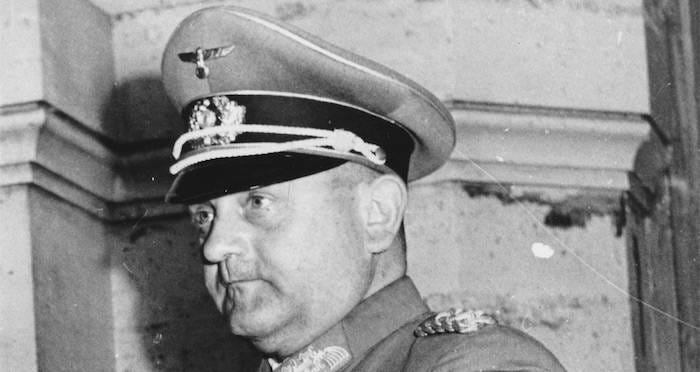
He had a reputation. In 1940, he ordered the Luftwaffe to bomb Rotterdam when it failed to surrender promptly. In 1941 and 1942, his troops bombarded Sevastopol continuously, devastating the city and its civilians. When Hitler needed someone to destroy a city before abandoning it, Choltitz was the name that came up.
That is precisely why he was appointed military governor of Paris.
The day before Choltitz arrived, Hitler met with him personally and gave his instructions: Paris was not to fall into Allied hands intact. Every bridge over the Seine was to be blown. Every monument, every museum, every structure of military or cultural significance - destroyed. Hitler confirmed the order by cable after Choltitz reached the city:
“The city must not fall into the enemy’s hand except lying in complete rubble.”
Choltitz reads the order. He begins making preparations. German engineers wire the bridges. Explosives are placed at key sites across the city. The Eiffel Tower. Notre Dame. The Louvre. The Pont Neuf. Everything is ready.
All that is needed is one command.
Choltitz does not give it.
THE DECISION:
Here is what Choltitz knows:
The Allies are closing in. The French Resistance has launched an insurrection inside the city. His garrison - weakened, poorly supplied, stretched thin - cannot hold Paris. The question is not whether Paris falls. The question is what state it is in when it does.
His orders are unambiguous. He has followed orders his entire career. He has destroyed cities before. His wife and three children are in Baden-Baden, Germany - and officers who disobey Hitler’s direct commands do not only pay themselves. Their families pay too.
Here is what is making Choltitz hesitate:
Berlin keeps calling. Telexes arrive demanding to know if Paris is burning as ordered. And each time, Choltitz finds a reason to delay - a tactical situation requiring clarification, a timing issue, a coordination problem. He is a man running out of excuses to not do the thing he has been specifically sent here to do.
He also knows - though he will spend years afterward crafting exactly how he describes this - that he has come to believe Hitler is no longer rational. That the war is lost. That destroying Paris will change nothing militarily, will not slow the Allied advance by a single day, and will cement his name in history as the man who burned one of the world’s great cities for no reason except that a madman told him to.
He turns to Swedish Consul Raoul Nordling - a neutral diplomat with access to both sides - and tells him something extraordinary: he passes a message to the Allies through Nordling’s brother. Come to Paris quickly. Before someone gives me an order I cannot delay any longer.
But here is where the history gets complicated.
Choltitz later told his story in a memoir that became a celebrated book and then a celebrated film. In his version, he is the lone heroic figure - the man of conscience who stood between Hitler’s madness and the city of light. Historians have since pushed back. Some argue that Choltitz never had the capacity to destroy Paris the way he claimed - that the German garrison was too depleted, too disorganized, too consumed with fighting the Resistance to execute a demolition of that scale. Some argue the Resistance itself deserves far more credit than Choltitz’s memoir ever gave them.
The truth, as historians tend to agree, sits somewhere in between.
Paris, August 1944. The explosives are planted. Berlin is calling. Your family is in Germany. The order is legal, direct, and carries your name.
Do you give the command?
WHAT HAPPENED:
Choltitz does not give the command.
On August 25th, 1944, surrounded at the Hotel Meurice and almost out of ammunition, he surrenders Paris to the French 2nd Armored Division. He signs the document formally ending German occupation of the city. The bridges are intact. Notre Dame is standing. The Louvre is unharmed.
That afternoon, Charles de Gaulle walks down the Champs-Elysées.
Choltitz is taken prisoner and spends the rest of the war in Allied captivity. He is treated well. He later writes his memoir, casting himself as the savior of Paris, the officer who looked at Hitler’s order and chose civilization over obedience. The book becomes a bestseller. The 1966 film based on it, Is Paris Burning?, is a major international production.
He is buried in 1966 - in Baden-Baden, with French military officers among his pallbearers.
The harder question - the one that never fully disappears - is how much of the legend is true. Choltitz had a powerful personal interest in being remembered as the man who saved Paris rather than the man who bombed Rotterdam and Sevastopol. The Resistance fighters who bled through three weeks of street combat to make the occupation untenable for the German garrison have largely vanished from the popular version of the story.
What is certain: Paris was not destroyed. What remains genuinely contested: exactly who deserves the credit - and how much of Choltitz’s heroism was a choice, and how much was a man running out of time to make a different one.
DIG DEEPER
“Is Paris burning?” - the famous quote is disputed. The popular account holds that Hitler phoned Choltitz directly, screaming “Brennt Paris?” - “Is Paris burning?” Most historians now believe the question was actually directed at Chief of Staff Alfred Jodl at Hitler’s Wolf’s Lair headquarters on August 25th, not to Choltitz personally. The image of Hitler raging into a phone at the general who defied him is almost certainly a dramatic embellishment.
Choltitz’s own SS officers nearly stopped him from delaying. When Choltitz agreed to a temporary ceasefire with the Resistance to allow both sides to retrieve their dead and wounded, four SS men arrived at his office shortly afterward. He initially assumed they had come to arrest him for the unauthorized truce. They had not - but the encounter illustrates how thin the margin was between delay and discovery.
The French Resistance’s role has been systematically underplayed. Historians argue that the three-week insurrection mounted by Resistance fighters - who seized police stations, government buildings, and key infrastructure before the Allies arrived - made it practically impossible for the depleted German garrison to execute a systematic demolition even if ordered. The story of one German general’s conscience is a cleaner narrative than the truth: thousands of anonymous French civilians who made the city ungovernable first.
Good . May I ask one thing how you cpnsistently and regularly post artickes of such quality and detail ?
Interesting.
"...the war is lost. That destroying Paris will change nothing militarily,..."
But I wonder if somethings could have left a change culturally.
If Hitler had destroyed City of London, just scorched it off the earth.
Could it have changed the course of international banking, after WW2?
Stopped it from going directly into Korea and Vietnam and the Middle East,
and everything ever since?
Maybe not, they could still do it through wallstreet and ohio.
But maybe it would have left the spider with one leg less.